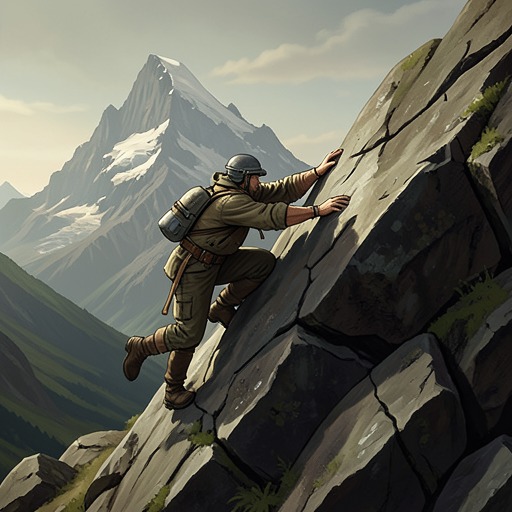
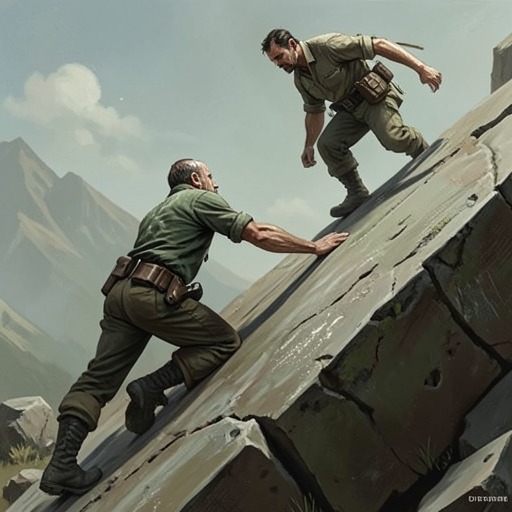
The struggle itself toward the heights is enough to fill a man’s heart
The Myth of Sisyphus“The struggle itself toward the heights is enough to fill a man’s heart” is the decisive formulation of Sisyphus’s happiness. It transforms an apparently futile punishment into a condition of conscious human freedom: because there is no higher destiny to complete or redeem his labor, the effort itself becomes sufficient. The sentence therefore gathers the book’s central movement from absurdity to revolt, affirming that a life can be fully inhabited even when its burden remains permanent.
Definition and Context
The expression appears at the conclusion of the Sisyphus meditation, after Sisyphus has been left at the foot of the mountain and before the final imperative that he must be imagined happy. His task remains unchanged: the rock must be raised, it must fall again, and he must return to it. The phrase does not deny the repetition or convert the punishment into an eventual success. Its force comes precisely from refusing that consolation. The heights are not a destination at which the labor will end; they name the direction of an effort that must begin again.
The statement also completes a sequence of reversals. Sisyphus’s fate initially appears to belong to the gods, but the text declares that his fate belongs to him and that his rock is his own thing. The punishment is still imposed, yet conscious recognition alters its significance. Once Sisyphus understands the terms of his existence, the apparently external sentence becomes the material of a human act: he raises the rock without appeal to a higher authority, and the act of raising becomes inseparable from his freedom.
The Labor of Sisyphus
The expression is inseparable from the image of Sisyphus returning toward his rock. At the subtle moment when he looks back over his life, a series of unrelated actions becomes his fate, formed by his memory and sealed by his death. This backward glance is not escape from the burden. It is the instant in which consciousness recognizes the whole pattern while the work remains unfinished. The rock is still rolling, and Sisyphus is still on the move; reflection and repetition therefore coexist rather than cancel one another.
His joy is described as silent because it does not depend on public triumph, divine recognition, or a change in circumstances. In the universe restored to silence, the idols are silenced as well, and the earth’s many small voices become audible as the necessary reverse and price of victory. The image of “There is no sun without shadow” makes the same point through contrast: lucidity must include the night. Sisyphus’s happiness is not innocence about suffering, but an awareness that accepts the whole condition without yielding its authority to it.
Freedom Without Transcendence
The sentence expresses the book’s distinction between personal fate and higher destiny. A personal fate may exist, but there is no higher destiny—or there is only one that the absurd person judges inevitable and despicable. What remains is mastery of one’s days. That mastery is limited, since Sisyphus cannot abolish the rock or alter the structure of his punishment; it is nevertheless real because he can determine his relation to what cannot be removed.
This is why the effort, rather than its result, fills the heart. A final achievement would place meaning beyond the present labor, whereas Sisyphus’s condition offers no completed project that could justify the repetitions retrospectively. The text instead locates value in sustained consciousness and action. His fidelity is “higher” because it negates the gods while continuing to raise rocks: revolt does not take the form of abandoning the task, but of performing it without submission to the task’s supposed cosmic meaning.
Paradox and Thematic Significance
The expression turns a contradiction into a principle. The labor is futile in its outcome, yet sufficient in its experience; the fate is imposed, yet belongs to Sisyphus; the universe has no master, yet it is neither sterile nor futile. Each paradox depends on the same refusal to seek meaning outside lived activity. The rock’s descent does not invalidate the ascent, because the ascent is no longer measured by permanent possession of the summit.
The closing image intensifies this interpretation. Each atom of the stone and each mineral flake of the night-filled mountain forms a world. The burden is therefore not reduced to a symbol that can be discarded once its meaning is understood. Its material weight remains present, and the world contained in it is encountered through repeated contact. The struggle toward the heights is enough because the struggle gathers consciousness, memory, revolt, and ownership into a single human practice.
Relation to Sisyphus’s Happiness
The expression prepares the final conclusion that Sisyphus must be imagined happy. Happiness here is neither pleasure nor release. It is the condition of a person who has recognized the wholly human origin of what is human and has accepted that the night has no end without surrendering to despair. Sisyphus’s happiness is thus compatible with exhaustion, repetition, and death; it consists in possessing the burden as his own while continuing to move.
The phrase serves as the culmination of the Sisyphus myth and of the broader argument about the absurd. Once the gods, higher purposes, and promised resolutions have been removed, the struggle itself becomes the measure of a life. The rock will roll again, but that recurrence no longer proves that all is futile. It is the setting in which Sisyphus exercises the only decisive freedom available to him: to know his condition, affirm his effort, and make his days his own.